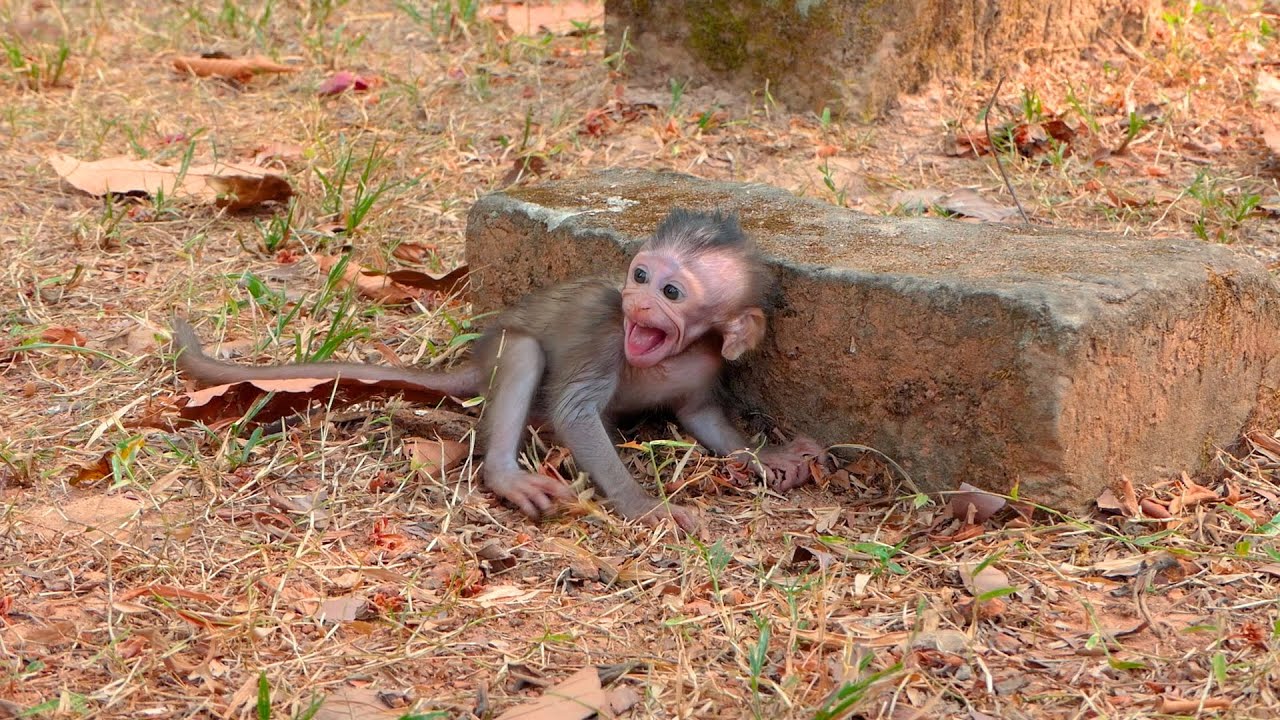
There is a moment in the life of nearly every young primate when the world suddenly feels very large and the one familiar presence it depends on feels very far away. For a tiny baby monkey filmed by Angkor Monkey Stories, that moment arrived in a burst of small, insistent cries — and what happened next says something significant about the way primate families work.
The footage, shared on the Angkor Monkey Stories YouTube channel, captures a young monkey calling out with unmistakable urgency while its mother moves nearby at an unhurried pace. To a casual observer, the scene might read as straightforward. But for anyone paying close attention to primate behavior, the dynamic on screen is layered with meaning.
Baby monkeys are among the most dependent of all young mammals. In the weeks and months following birth, an infant monkey is rarely separated from its mother for any meaningful stretch of time. Physical contact — clinging, carrying, grooming — forms the foundation of early development. When that contact is briefly interrupted, even by a short distance, the response is often immediate and vocal.
The crying heard in the footage is not simply a sign of distress. It is communication. It is the infant’s primary tool for signaling its location, its needs, and its vulnerability. And crucially, it works. The mother, calm and apparently unfazed, moves back toward her young one — a response that reinforces the bond and teaches the infant, over time, that the world is safe, that its calls are heard, and that its mother will return.
This behavioral loop — cry, respond, reassure — is something researchers who study primate attachment have documented extensively. It mirrors patterns seen in human infants and their caregivers, which is part of why footage like this tends to land so powerfully with audiences. The emotional architecture looks familiar because, in evolutionary terms, it is.
For viewers who encounter this kind of footage on channels like Angkor Monkey Stories, the appeal goes beyond simple cuteness. It connects people to something older and larger than themselves — a reminder that the instinct to call out for comfort, and the instinct to answer that call, are not uniquely human experiences.
The Angkor region of Cambodia, where the channel documents monkey life, provides a rich environment for this kind of observation. Troops of macaques and other species navigate daily life in complex social groups, where relationships between mothers and offspring anchor the broader community structure.
In a media landscape crowded with dramatic wildlife footage, there is something quietly powerful about a video that finds its significance in a moment of ordinary tenderness. A baby cries. A mother comes closer. A small body relaxes into safety.
It is a story told without words, in a language older than language itself.
Source: Angkor Monkey Stories, YouTube.
Watch the original video →